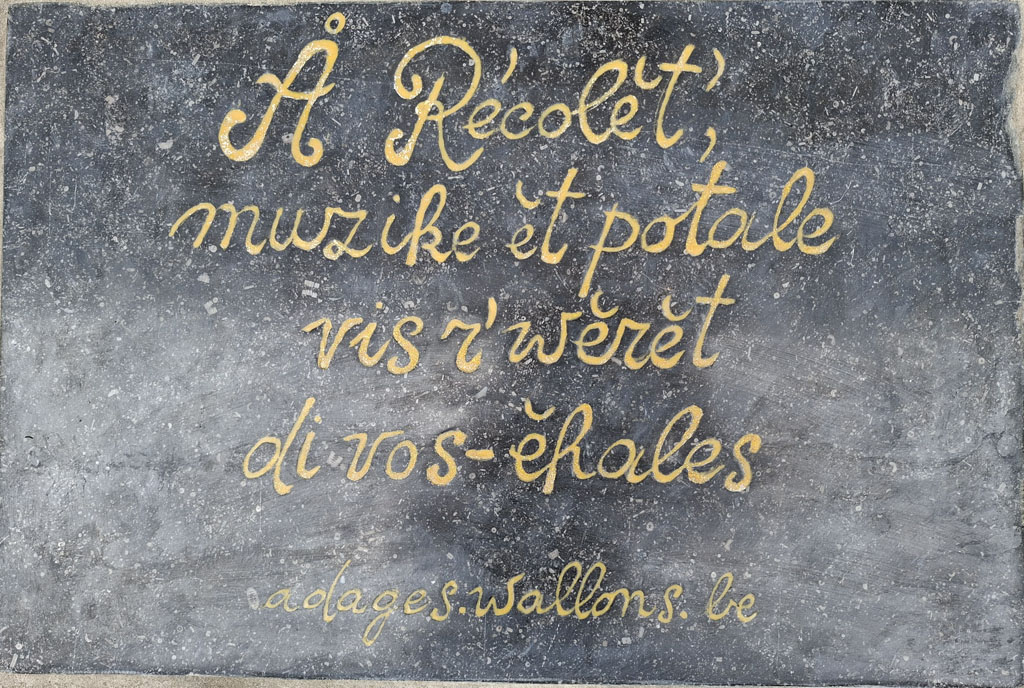
Å Récolèt’, muzike èt potale vis r’wèrèt di vos-èhales.
At Les Récollets, music and “potales” heal you of your worries.
In Walloon, the term potale originally refers to a niche in the façade of a house designed to hold a statue of a saint. More broadly, it is also used to describe a small wooden chapel containing such a statue. In Liège, these most often feature an image of the Virgin Mary. Although potales can be found in several historic working-class neighbourhoods across Liège, they are especially numerous in Outremeuse.
In addition to its beautiful potale, Rue des Récollets is lined with many typical old houses, including the birthplace of André-Ernest-Modeste Grétry, as indicated by the inscription on the façade. Grétry began his musical education in Liège before going on to achieve great success in Paris, where he even became music director to Queen Marie-Antoinette. Despite his success in France, he never forgot his hometown and remained deeply attached to it. After his death, his heart was returned to Liège, in accordance with his wishes, and placed in an urn that can still be seen today in the pedestal of his statue, opposite the Royal Opera. Naturally, the life of this great composer cannot be summed up in just a few lines. You can discover more about it at the museum housed in his birthplace.